
In September of 2025 we at WISER noticed a potential for cost savings that we hadn’t before. One of our highest-consumed items for simulation, the manikin neck skin, is also a rather costly one, running about $50 each. It’s essentially a longer rectangle of rubber with a fastener, usually Velcro, that wraps around the neck of a manikin. Our IT Specialist, Elliott, is a hobbyist 3D printer that noted there are TPU filaments manufactured that would likely match the neck skin material quite closely. After an initial roll was purchased, he began at-home test printing these neck skins to determine feasibility. Almost from the get-go the products produced were not only a great success, but cost almost 1/10th of the price to produce.
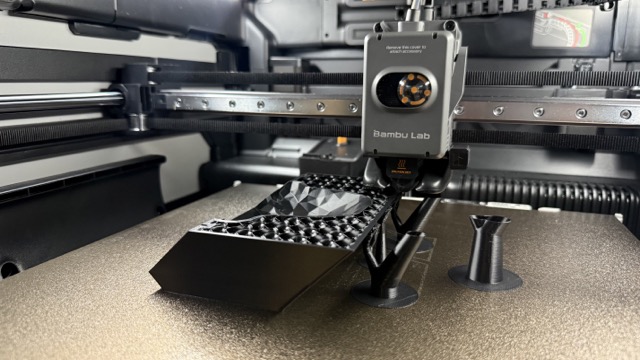
In December of 2025, WISER was approved for and acquired a brand new Bambu Labs H2S machine. This machine is much higher-end and prevents lots of common issues before they happen with built-in calibration, making it much easier to achieve a desirable and repeatable result. We began producing more neck skins while simultaneously optimizing print times from eight hours down to four. This led us to wonder what else we could “optimize”.
Since then, we’ve started looking at other consumable items that we use and formulating ways to replicate them ourselves. These range from IO trainers to other manikin parts that take wear over time, to ultrasound-able block trainers. Not all of these can be directly 3D printed, such as the block trainers, but we can use the printer to make molds to cast other materials into. We’ve started investigating other materials like silicone, and ballistics gel, as well as cheaper “homemade” alternatives that are both guar and agar based.