
Greetings friends of WISER.
IMSH
Our time in San Antonio for IMSH 2026 was an outstanding success by every measure.
WISER’s booth presence was one of our most engaging to date. From reconnecting with long-standing collaborators to meeting new simulation professionals exploring faculty development, fellowship, simulation operations training, systems integration, and simulation center strategy, the conversations were energetic and forward-looking.
I had the privilege of presenting on the main stage to report on the outcomes of the 2025 Forum on the Future of Simulation. The session synthesized themes from global leaders in simulation and healthcare innovation, highlighting digital ecosystems, AI integration, distributed simulation models, and the growing imperative to link simulation directly to measurable patient safety outcomes. The discussion reinforced that simulation is no longer peripheral to healthcare; it is foundational to the design of safer systems moving forward.
Beyond the main stage, our WISER team delivered multiple educational sessions throughout the meeting. From faculty development to operational strategy and assessment design, the depth of expertise across our team was evident. I am deeply proud of how our faculty represented both WISER and the broader UPMC and University of Pittsburgh community.
Patient Safety Report
Also, we are proud to be distributing our bi-annual Patient Safety Report, a comprehensive summary of the patient-safety–focused simulation initiatives supported by WISER across the UPMC system and the University of Pittsburgh community. The report highlights how simulation is being intentionally deployed to address high-risk clinical scenarios, improve team communication, strengthen systems testing, and measurably advance the quality and safety of care. It reflects the collective work of our clinical partners, educators, and operational leaders who view simulation not as an isolated educational tool, but as an integrated strategy for safer healthcare delivery. The report is available in both hard copy and online formats, and we invite you to review it to better understand the scope and impact of our ongoing patient safety efforts.
Improving Simulation Instructional Methods (iSIM)
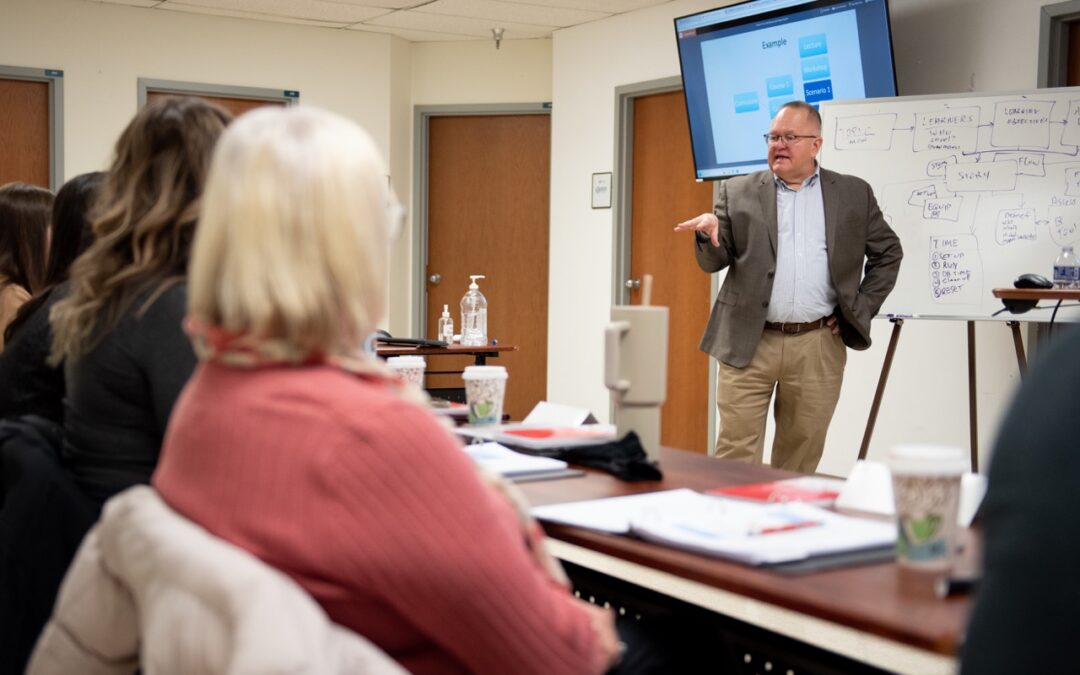
We recently completed another highly successful iSIM Fundamentals course at WISER. Each cohort reminds us why this program continues to thrive: thoughtful participants, disciplined instructional design, and a shared commitment to elevating simulation practice throught the teaching of best practices.
The conversations around scenario architecture, debriefing intentionality, and learner-centered design were particularly rich this session. It is rewarding to see participants leave not just with tools, but with a more systematic way of thinking about simulation instruction.
We are already looking forward to our next iSIM course in June and anticipate another strong group of educators ready to deepen their understanding and capabilities as simulation professionals.
WISER@Scaife
Behind the scenes, we are overseeing the finishing touches of WISER@Scaife, our new space dedicated to meeting the simulation and experiential learning needs of the students of the University of Pittsburgh School of Medicine.
This space represents a meaningful investment in learner-centered design. It will support integrated clinical skills training, team-based experiential learning, and structured simulation experiences embedded directly within the medical student curriculum. Our goal is alignment—ensuring that experiential learning environments complement didactic teaching and clinical immersion in a seamless way.
The launch of WISER@Scaife reflects a broader institutional commitment to preparing future physicians not only with knowledge but with applied competence, systems awareness, and professional identity formation.
Simulation continues to evolve from a training methodology to a systems-level strategy for healthcare improvement. At WISER, we remain committed to thoughtful design, rigorous assessment, and meaningful outcomes.
Thank you to our faculty, staff, partners, and learners who make this work possible. The year is off to a strong start, and the best is yet to come.
Until Next Time,
Paul
Happy Simulating