
November 2026 | The People, Innovation, and Momentum Behind WISER
As we approach the end of another year at WISER, I sometimes wonder where the time has gone! It seems like something new is always happening, whether it is an innovative educational project, a new simulation capability, or another opportunity to support our colleagues across UPMC and the University of Pittsburgh. One of the things I enjoy most about my role is seeing the creativity and dedication of our team and the faculty members they support as they continue to find new ways to make a difference.
Several exciting developments have happened over the past few months, and I want to take this opportunity to share a few highlights and recognize some of the people who make them possible.
Celebrating Our People
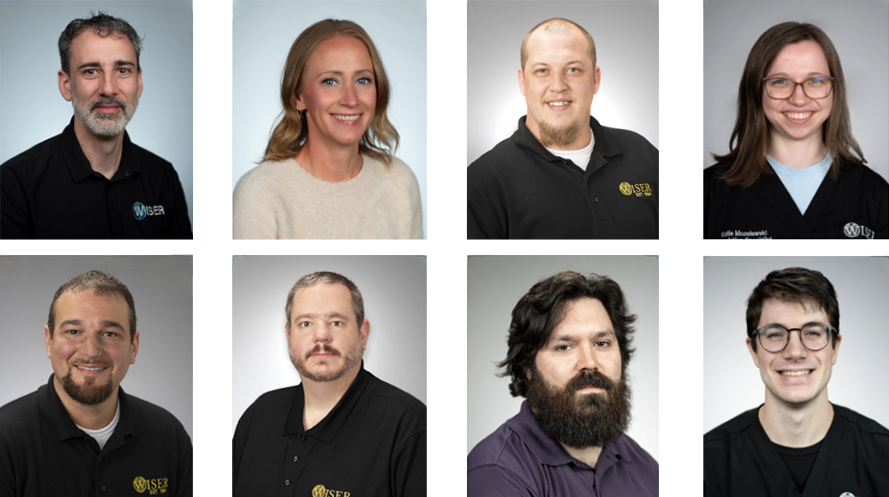
I want to start with an accomplishment that makes me particularly proud. Every eligible simulation specialist on our Operations team has now earned the Certified Healthcare Simulation Operations Specialist (CHSOS) credential!
Anyone who has worked in healthcare simulation knows that simulation operations professionals do much more than set up equipment and run mannequins. These individuals combine technical expertise, creativity, problem-solving, and an understanding of educational goals to help bring our programs to life. Much of their work takes place behind the scenes, and when everything runs smoothly, it can be easy to overlook just how much preparation and expertise went into making that happen.
Having our entire eligible team achieve CHSOS certification is a wonderful reflection of their professionalism and commitment to continuous improvement. I hope everyone will join me in congratulating them on this impressive milestone!
Another accomplishment worth celebrating belongs to Joe Wheeler, CHSOS, who recently completed his support of his 200th mock code! That is an incredible number of opportunities to help healthcare teams prepare for situations in which every second can matter.
Our mock code program represents one of the clearest examples of simulation’s connection to patient safety. These exercises allow teams to practice working together in their actual clinical environments while also helping identify systems issues that might otherwise go unnoticed. Over the years, Joe has become a familiar face in UPMC hospitals, and his dedication to this work is remarkable. Joe, congratulations on reaching number 200, and thank you for the tremendous effort you put into helping our clinical teams prepare for the unexpected.
Continuing to Grow and Innovate
Exciting work is also underway as we continue to expand our capabilities at WISER@Scaife for the University of Pittsburgh School of Medicine. We are steadily increasing simulation activities, refining our workflows, and finding new ways to take advantage of the technology and educational opportunities available in this remarkable facility.
Our IT team recently shared a behind-the-scenes video tour of the simulation control rooms at Scaife. I encourage you to watch it if you haven’t seen it. It provides a glimpse of the sophisticated systems that support our simulation activities and reminds us of the tremendous technical expertise required to make these experiences possible.
Another area that I find particularly exciting is our growing capability in 3D printing and silicone modeling. Our team has been experimenting with ways to design and produce customized simulation materials, including realistic multilayer silicone models for practicing suturing skills, variations of skins for simulators as well as creating simulated wounds. By using 3D-printed molds and silicone fabrication techniques, we can create task trainers tailored to specific educational needs.
What I like most about this work is the opportunity it creates for our educators, clinicians, and simulation specialists to collaborate on solutions to educational challenges. Rather than always looking for something commercially available, we increasingly ask, “What exactly do our learners need, and could we build it ourselves?” I think that approach has tremendous potential, and I look forward to seeing where these efforts take us.
We also continue to provide important support to the UPMC Schools of Nursing, helping them incorporate simulation into their curricula and prepare the next generation of nurses. This work reflects the breadth of WISER’s educational mission and the many ways our team contributes to healthcare education throughout the system.
In October, we successfully completed another iSIM Fundamentals course. Our team always enjoys seeing educators come together to learn more about simulation-based education, exchange ideas, and develop new skills. These courses also remind me how fortunate we are to have such a knowledgeable and experienced group of instructors and simulation specialists willing to share their expertise with others.
WISER Heads to New Orleans!
Looking a little further ahead, I am excited about our upcoming participation in the International Meeting on Simulation in Healthcare (IMSH), January 23–27, 2027, in New Orleans. IMSH is always a wonderful opportunity to reconnect with colleagues, exchange ideas, and learn about developments across our field. It is also an opportunity to showcase some of the innovative work happening at WISER.
This year, we have several team members sharing their expertise.
Kimberly Mitchell and Elliott Finney will present From Data to Dashboard: A Free AI Toolkit for Simulation Centers, demonstrating some practical ways artificial intelligence can support simulation operations and program management.
John O’Donnell and I will facilitate a hands-on workshop introducing the RST (Rater, Simulation, Tool) model, a framework for thinking more systematically about simulation-based assessment. Participants will explore how the interaction among raters, simulations, and assessment tools can influence the reliability and defensibility of assessment results. John and I have spent considerable time exploring this topic, and I look forward to sharing it with colleagues at IMSH.
Then I will also join Geoffrey Miller for a workshop titled Sound Advice for Simulation Professionals. We will focus on practical, affordable ways to improve audio quality in educational video production. This topic may not always get much attention, but anyone who has struggled with poor audio in an otherwise excellent instructional video knows how important it can be!
We will also have a WISER and SIMS presence at Booth 1731 in the exhibit hall. If you are attending IMSH, please stop by and say hello. I am looking forward to seeing our team represented so well in New Orleans.
Looking Toward 2027
As I look at all of these accomplishments, one common thread stands out: the people behind the work. Whether they support a mock code, develop a new task trainer, facilitate a simulation, manage educational technology, or keep our many programs running smoothly, their contributions make WISER successful. It is easy to focus on new facilities, technology, and programs, but none of them accomplish much without talented, committed people bringing them to life.
I am grateful to work alongside such an extraordinary group of colleagues. Thank you to everyone who continues to contribute ideas, solve problems, support one another, and move our mission forward.
I hope everyone has a wonderful end to 2026, and I look forward to what we will accomplish together in the year ahead!
Until Next Time,
Happy Simulating!
Paul E. Phrampus, MD, MBA, FSSH, CPE, CHSE, CHSOS Director, WISER